



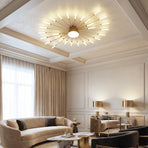

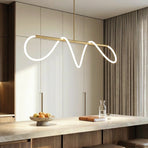



You have the table. Now you need a chandelier that looks like it belongs over it, not one that floats too high or crowds everyone's heads. The good news: it comes down to three measurements you can take with a tape measure in five minutes.
Quick answer
- Width: choose a chandelier about ½ to ⅔ the width of your table. On a 48 in (122 cm) round table, that is roughly 24–32 in (61–81 cm) across.
- Height: hang the bottom of the fixture 30–36 in (76–91 cm) above the tabletop with an 8 ft (2.4 m) ceiling.
- Taller ceilings: add about 3 in (7.5 cm) per extra foot (30 cm) of ceiling height.
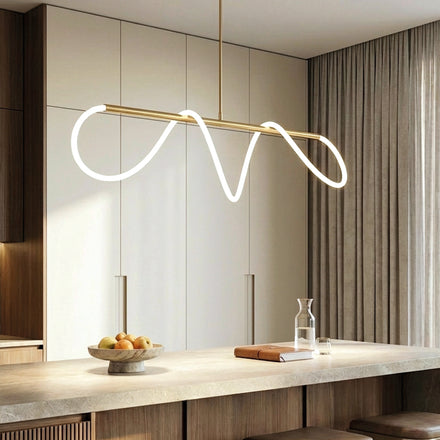
- Long tables (72 in / 183 cm and up): use a linear chandelier about ½ to ⅔ the table's length, or two fixtures.
These are common designer rules of thumb, not hard laws. Below we explain each one and work through four real table sizes.
The 3 rules that solve most dining rooms
Width: ½ to ⅔ of the table
Measure the width of your table (the diameter for a round table, the short side for a rectangle). A chandelier between half and two-thirds of that number reads as "in proportion." Smaller looks like an afterthought; bigger starts to crowd your guests.
A second guideline lighting designers use: keep the fixture at least 12 in (30 cm) narrower than the table, so there's about 6 in (15 cm) of breathing room on each side. That stops people from bumping it when they stand up and keeps it from overhanging the edge.
If you don't have a table yet, there's a room-based shortcut: add the room's length and width in feet, and use the total as the chandelier's diameter in inches. A 12 × 14 ft room gives 26, so a fixture around 26 in (66 cm) across. Once the table arrives, let the table rule win.
Height above the table: 30–36 in (76–91 cm)
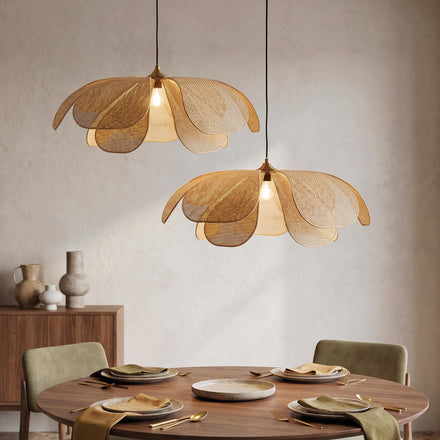
Measure from the tabletop to the bottom of the chandelier, not from the floor. With a standard 8 ft (2.4 m) ceiling, 30–36 in (76–91 cm) puts the light low enough to feel intimate and pool on the table, but high enough that people can see each other across it.
The most common mistake, and a frequent topic in decorating forums, is hanging the chandelier too high. It makes the fixture look smaller and the light harsher.
Taller ceilings: add about 3 in (7.5 cm) per extra foot
Higher ceilings can take a slightly higher fixture so it doesn't look like it's dangling on a long string. A common guideline is to add about 3 in (7.5 cm) of clearance for every foot (30 cm) of ceiling above 8 ft:
| Ceiling height | Bottom of chandelier above the table |
|---|---|
| 8 ft (244 cm) | 30–36 in (76–91 cm) |
| 9 ft (274 cm) | 33–39 in (84–99 cm) |
| 10 ft (305 cm) | 36–42 in (91–107 cm) |
| 12 ft (366 cm) | 42–48 in (107–122 cm) |
Many designers still keep the light close to the 30–36 in range even under tall ceilings, and use a taller or multi-tier fixture to fill the vertical space instead. For the fixture's own height, a common rule is 2.5–3 in per foot of ceiling: about 22–27 in (56–69 cm) for a 9 ft ceiling.
Round, square or rectangular table: which shape of fixture?
Round and square tables: round, drum or organic fixtures
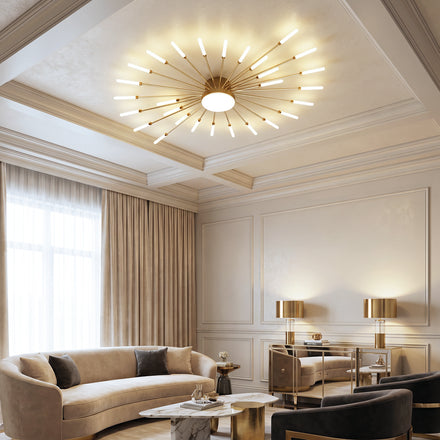
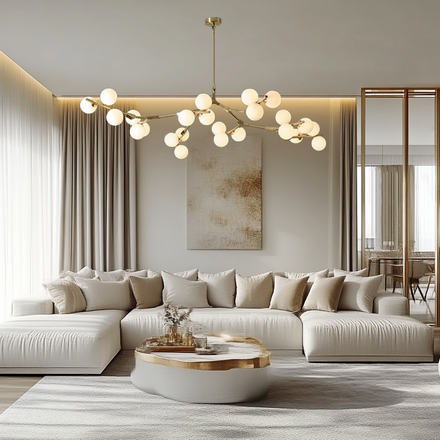
A round fixture over a round or square table mirrors its shape and lights every seat evenly. Ring chandeliers, drums, globe clusters and branch-style pieces all work. Hang it centered on the table, not on the room, if the two don't line up.
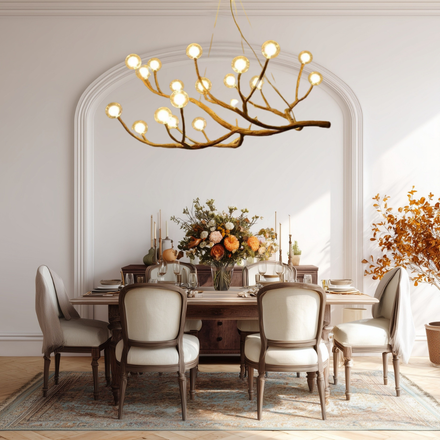
Open and organic fixtures, like branches, glass bubbles or slim rings, look lighter than a solid drum of the same diameter, because you see through them. If you're between two sizes of an airy design, the larger one usually looks right. Our Nordic Rustic Tree Branch Hanging Chandelier is a good example: its product page suggests the 8-light version for small tables, 12 lights for a typical dining room, and 16 or 20 lights for larger tables.
Long tables (72 in / 183 cm and up): linear or two fixtures
A single round chandelier over a long rectangle leaves the ends of the table dim. A linear chandelier fixes that. Size it to about ½ to ⅔ of the table's length, and leave at least 6 in (15 cm) at each end. For very long tables, two matching round fixtures spaced evenly along the table work too.
Worked examples: four common tables
Here's how the rules play out on four standard table sizes, paired with fixtures from our chandeliers for dining room collection whose listed sizes fit the range. All sizes below are taken from each product's own page.
| Table | Target fixture size | Example that fits | Drop (8 ft ceiling) |
|---|---|---|---|
| Round, 48 in (122 cm) | 24–32 in (61–81 cm) diameter | Luxury Cream Style Chandelier, 72 cm / 28.4 in | 30–36 in (76–91 cm) above table |
| Round, 60 in (152 cm) | 30–40 in (76–102 cm) diameter | Luxury Cream Style Chandelier, 80 cm / 31.5 in | 30–36 in (76–91 cm) above table |
| Rectangle, 72 in (183 cm) long | 36–48 in (91–122 cm) long, linear | Wood Linear Suspension Chandelier, 120 cm / 47.2 in | 30–36 in (76–91 cm) above table |
| Rectangle, 96 in (244 cm) long | 48–64 in (122–163 cm) long, linear | Designer Dining Room Chandelier, 150 cm / 60 in | 30–36 in (76–91 cm) above table |
Round 48 in (122 cm) table
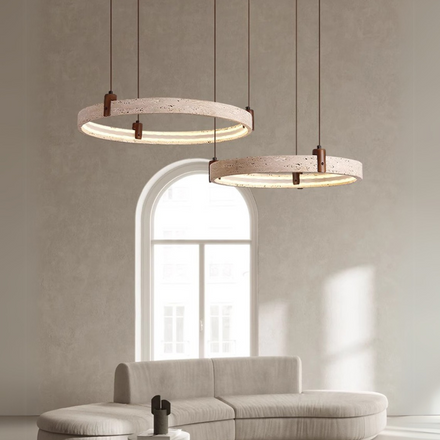
Half to two-thirds of 48 in is 24–32 in. The Luxury Cream Style Chandelier comes in 52, 62, 72 and 80 cm sizes; the 72 cm (28.4 in) ring lands right in the middle of the range and leaves almost 10 in (25 cm) of clearance on each side. If your room is small or the ceiling is low, the 62 cm (24.4 in) size still fits the rule.
Round 60 in (152 cm) table
A 60 in table wants a fixture about 30–40 in across. The same Luxury Cream Style Chandelier in 80 cm (31.5 in) fits. Under a 10 ft or higher ceiling, its two-tier 80 + 62 cm version fills more vertical space without getting wider. Its wire cable is listed at 150 cm (47 in), so check that it covers your drop (more on that below).
Rectangle 72 in (183 cm) table
For a 72 × 36–40 in (183 × 91–102 cm) table, a linear fixture of 36–48 in (91–122 cm) is the target. The Wood Linear Suspension Chandelier in 120 cm (47.2 in) leaves about 12 in (31 cm) at each end. Its page lists warm, neutral and cold light options plus a 3-color dimming version with a remote, and an adjustable 200 cm (80 in) hanging wire. If you prefer a round fixture here, size it to the table's width instead: about 24–28 in (61–71 cm).
Rectangle 96 in (244 cm) table
An 8 ft table needs a linear light of roughly 48–64 in (122–163 cm). The solid black walnut Designer Dining Room Chandelier Light comes in 150 cm (60 in), which is right on target, and in sizes up to 300 cm (120 in) for banquet-length tables. One thing to note: it hangs from a pole listed at 50 cm (19.6 in) adjustable, and the page asks you to contact the store if you need it longer. On a tall ceiling, ask before you order.
Is my chandelier too small? 4 signs, and the fixes
- It's less than half the table's width. For example, a 25 in fixture over a 72 in table, a real question we've seen in decorating forums.
- The table ends are noticeably darker than the center. Typical with a round fixture over a long table.
- It hangs more than about 36 in (91 cm) above the table on an 8 ft ceiling. Height makes a fixture read smaller.
- It disappears when you stand in the doorway.
Fixes, from easiest to biggest: lower it into the 30–36 in range (often a simple cord adjustment); add a second matching fixture over a long table; or size up to a fixture that meets the ½–⅔ rule.
Pendant or chandelier for the dining room?
Both work. A chandelier is a single focal point and suits round tables and formal rooms. A row of two or three pendants spreads light along a long table and feels more casual. If you go with pendants, treat the group as one fixture: the whole row should still span about ½ to ⅔ of the table's length, at the same 30–36 in height. Many of the pendants in our kitchen chandeliers and pendants collection work over a dining table as well as an island.
Bulbs and dimming for dining
For dinner, warm light around 2700–3000K is the usual choice: it flatters food and faces. Cold white (around 6000K) is better for kitchens and work areas. The fixtures in this guide come in warm white and cold white, and some, like the Wood Linear Suspension Chandelier, also have a remote-dimmable version. A dimmer is the best upgrade for a dining room: bright for a family meal, low for a long dinner. With integrated LEDs, check which dimming option the listing supports before adding a wall dimmer.
Buying a chandelier online: what to check
- Exact dimensions: the diameter or length and the fixture's own height. Compare them to your table using the rules above.
- Cord, wire or rod length: work out the drop you need: ceiling height − table height (usually about 30 in / 76 cm) − your chosen clearance − fixture height. On an 8 ft ceiling with a 30 in table and a 33 in clearance, the bottom of the light sits about 33 in (84 cm) below the ceiling. Make sure the listed cord covers it.
- Customization: several of our listings invite you to contact us if you need a longer wire or pole. Our returns policy excludes custom or personalized orders, so measure twice before asking for a custom length.
- Voltage and installation: the fixtures named in this guide list 110–260V, which covers standard household power in North America and Europe. For a hardwired fixture, we recommend a qualified electrician.
Rufat Lights offers free worldwide shipping with customs and duties covered, and you can request a return within 60 days of receiving an eligible item. Browse the full dining room lighting collection, or see our earlier roundup of dining room chandelier picks for style ideas.
FAQ
How big should a chandelier be over a dining table?
A common rule of thumb is ½ to ⅔ of the table's width, and at least 12 in (30 cm) narrower than the table. For a 48 in (122 cm) round table, that's about 24–32 in (61–81 cm). For a long rectangular table, use a linear fixture about ½ to ⅔ of the table's length.
How high should a chandelier hang over a dining table, and does it change with a 9 or 10 ft ceiling?
With an 8 ft ceiling, hang the bottom of the chandelier 30–36 in (76–91 cm) above the tabletop. A common guideline adds about 3 in (7.5 cm) per extra foot of ceiling: roughly 33–39 in (84–99 cm) for 9 ft and 36–42 in (91–107 cm) for 10 ft.
What size chandelier for a round table versus a long rectangular table?
For a round table, use a round fixture about ½ to ⅔ of the table's diameter: about 30–40 in (76–102 cm) for a 60 in (152 cm) table. For a long rectangular table, use a linear fixture about ½ to ⅔ of the length, such as 48–64 in (122–163 cm) over a 96 in (244 cm) table, or two round fixtures.
Is my chandelier too small?
Probably, if it's less than half the table's width, the table ends look dim, or it hangs well above 36 in (91 cm) on an 8 ft ceiling. Try lowering it first, then add a second fixture or size up.
Linear chandelier or round chandelier over a long table?
For tables 72 in (183 cm) and longer, a linear chandelier usually lights the whole surface more evenly than a single round one. A round fixture works over a long table if you size it to the table's width and accept softer light at the ends, or use two.
Pendant or chandelier for the dining room?
Either works. A chandelier makes a single focal point and suits round tables and formal rooms. A row of pendants spreads light along a long table. Size a row of pendants as if it were one fixture.
Is there a quick dining room chandelier size calculator?
Yes, two quick formulas. Table: multiply the table's width by 0.5 and 0.67 to get your diameter range. Room: add the room's length and width in feet; the total is a good diameter in inches. Then hang the light 30–36 in (76–91 cm) above the table, plus about 3 in per foot of ceiling over 8 ft.


